12th FOKUS FUSECO Forum 2024: Forward to 6G!
Understanding 5G Evolution Driven by Open Campus Networks, 6G RAN, Core Network Evolution, Non-terrestrial Networks and Data-/AI-based Networking
In the middle of 6G research and development and still within the pre-standardisation phase, we are happy to welcome old and new friends from all over the world to our institute in Berlin again.
In its role as an internationally recognised industry-oriented event, the FUSECO Forum mirrors the lessons learned from global public and private 5G network deployments and 5G evolution research and standardisation, while at the same time, we can witness increasing interest in private industrial campus network deployments and industries preparing to become ready for the 6G age.
A third workshop was organised on the first day of the FOKUS FUSECO Forum, the 7th of November 2024, on Track 3.
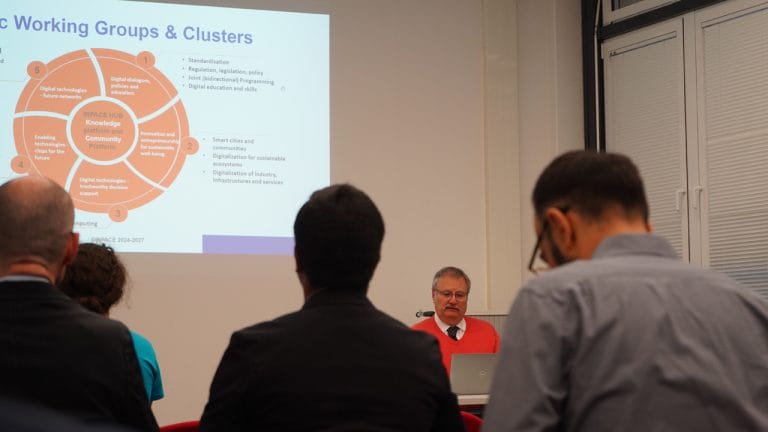
ABOUT THE WORKSHOP: INPACE Workshop “5G and Beyond – Topics of Common Interests between Japan, Republic of Korea, Singapore, India, and Europe”
A workshop organised by the Horizon Europe support action INPACE.
Chair: Adam Kapovits, Eurescom GmbH, Germany
Welcome and Introduction to the Horizon Europe INPACE Support Action and the Digital Partnerships between the EU and the Republic of Korea, Japan, and Singapore
Adam Kapovits, Eurescom GmbH, Germany
Cross-Industry Orchestration Enabled by Beyond 5G and 6G
Kentaro Ishizu, National Institute of Information and Communications Technology (NICT), Japan
The ESA SATis5 Activity – Results from the Collaboration with Japanese Consortium
Adam Kapovits, Eurescom GmbH, Germany
Stochastic Geometry for 5 and 6G Networks
François Baccelli, INRIA/Télécom Paris, France
AGENDA
Chair: Adam Kapovits, Eurescom GmbH, Germany
- Welcome and Introduction to the Horizon Europe INPACE Support Action and the Digital Partnerships between the EU and the Republic of Korea, Japan, and Singapore
Adam Kapovits – Eurescom GmbH, Germany - Cross-Industry Orchestration Enabled by Beyond 5G and 6G
Kentaro Ishizu – NICT, Japan
This presentation gives an overview of Beyond 5G/6G R&D activities at NICT especially focusing on a vision of Society 5.0 and cyber physical system (CPS). One more important vision of cross-industry orchestration, where not only networking systems but also other systems such as electricity and transportation are harmonized, is also explained with some use cases. It is expected that this talk motivates the participants to discuss together the vision of future infrastructure and find better architecture enabled by Beyond 5G and 6G. - The ESA SATis5 Activity – Results from the Collaboration with Japanese Consortium
Adam Kapovits – Eurescom GmbH, Germany
SATis5 aims to build a large-scale real-time live end-to-end 5G integrated satellite terrestrial network proof-of-concept testbed. The demonstrator testbed implements, deploys and evaluates an integrated satellite-terrestrial 5G network, showcasing the benefits of the satellite integration with the terrestrial infrastructures as part of a comprehensive communication system. Relevant satellite use cases for 5G to be demonstrated in SATis5 include enhanced mobile broadband (eMBB) and massive machine type communications (mMTC). The SATis5 demonstrator covers live, over-the-air GEO and MEO satellite field demonstrations in addition to laboratory emulations and simulations in a federation of testbeds. The demonstrator is an open federation of resources that can integrate or incorporate additional resources and testbeds in the future providing a more diverse set of experiments and demonstrations. - Stochastic Geometry for 5 and 6G Networks
François Baccelli – INRIA/Télécom Paris, France
Stochastic Geometry is now commonly used for analyzing spectrum sharing in large wireless networks. In this approach, network elements, such as users and base stations, are represented as point processes in the Euclidean plane, and interference fields as spatial shot-noise processes. The analytical machinery of stochastic geometry and basic formulas of information theory can then be combined to predict important spatial statistics of such networks. 6G is based on the use of several new types of network elements (e.g. reconfigurable intelligent surfaces/RISs), frequencies (e.g. Millimeter wave or THz), and architectures (e.g. cell-free, non terrestrial networks), and needs to support new services (such as integrated sensing and communication/ISAC), and becomes thus more complex. Mastering the complexity that results from this multiplicity requires the development of new stochastic geometry tools. The talk will survey some first steps in this direction, some of which were obtained jointly with South Korean colleagues including Chang-Sik Choi, Junse Lee and Namyoon Lee.