



ABOUT THE CONFERENCE
The 12th IEEE International Conference on Network Softwarization (IEEE NetSoft 2026) will be held in Berlin, Germany, from 29 June to 3 July 2026. Network Softwarization refers to the transition from legacy network infrastructures and functionalities traditionally provided via hardware appliances to new ones provided via software. This technology has become feasible with the maturity of network function virtualisation, software-defined networking, and service function chaining in the last 16 years. In particular, the ability to program, manage, and operate network and service infrastructures more freely makes it possible to reinvent network & cloud architecture, customize services, accelerate service deployment, and facilitate greater operational efficiency. This is even more relevant nowadays, as network infrastructures and service deployment technologies are challenged by the growing interest in distributed Artificial Intelligence (AI) and computing solutions. The need for further advances in these topics is reflected in the overall theme of NetSoft 2026: “Autonomous and Reliable Softwarized Networks in the Age of Distributed Intelligence”.
AGENDA
Monday, June 29 – Room: Auditorium 2
13:30 – 13:40 SDSI 2026 – Opening
Session Chair: Adam Kapovits, EURESCOM, Germany
13:40 – 14:20 Keynote
Session Chair: Maria Guta, European Space Agency, The Netherlands
Software Defined Space Infrastructures – an Overview of a Phenomenon, and its State of Play
by Adam Kapovits, EURESCOM, Germany
Abstract: Space solutions rely on special hardware: i) adapted to the harsh space environment and tolerating much increased level of radiation, ii) thermal management that takes into account that thermal radiation is the only way to dump and get rid of excess heat in space, and iii) being much more constrained in regard to available power, mass and physical size.
Consequently, space HW is generally considerably more constrained and has significantly less capacity than terrestrial counterparts. Also, as a result of that, historically space solutions were very specialised to the mission they were serving. With the rapid emergence and success of the software defined concept in other areas, we see a radical change starting in space solutions as well in this regard. Space economics also dictates a gradual convergence between dedicated infrastructures towards unified multi-mission infrastructures leveraging at least in part on the momentum in 6G towards Integrated Sensing and Communication.
In addition to the HW affecting the processing and storage part of communication networking, the transmission side and specifically routing is an aspect that requires complete re-thinking in space. With the emergence of large satellite constellations, routing of traffic between the nodes of the network and management of transmission capacities in general becomes an issue. In order to maintain their orbital trajectories, non-geostationary satellites continuously change their position, which directly implies that the space network topology is in permanent motion and subject to systematic, yet highly dynamic configuration changes. As such, the resulting network is completely distinct from the very slowly evolving terrestrial systems, rather being an environment in which nodes, links, and coverage relationships change at a temporal frequency and spatial granularity that is orders of magnitude higher than in ground-based networks, requiring that long-established notions have to be reconsidered: for example a space-based gNodeB is no longer a stationary access point with a stable neighbourhood, but a moving network element whose connectivity graph, service area, and interaction context evolve continuously as a function of its orbital position. This is a fundamentally different network, requiring an appropriate re-thinking of the different architectural and procedural solutions compared to terrestrial counterparts including routing, service placement and availability and overall network management.
The keynote will address the above aspects and other challenges for this vision of flexible and software defined space infrastructures, indicating potential direction of solutions to them.

Bio: Adam Kapovits joined Eurescom as programme manager in 1999. Since 2012 he managed a number of ESA Advanced Research in Telecommunications Systems and Space for 5G/6G and Sustainable Connectivity research projects focusing on the integration of terrestrial mobile systems with satellite communication systems. Currently he leads the 5GEOSiS and 6G SmartSat activities of the European Space Agency, both related to software defined space infrastructures. The 5G Earth Observation Server in Space activity looked at SW defined dynamically repurposable compute and processing resource in space and demonstrated that such a resource can be suitably and dynamically re-tasked on demand. The 6G SmartSat looked at beyond 5G/6G networking architectures for multi-layered large satellite constellations of smart satellites and developed solutions for routing traffic in such constellations, another critical aspect of software-defined space infrastructures.
14:20 – 15:00 TS #1: Technical Session #1
Session Chair: Eva Lagunas, SnT-University of Luxembourg, Luxembourg
Multi-Criteria Conditional Handover in 5G NTN Mega-Constellations
Manar Zaboub, Marius Corici and Hauke Buhr (Fraunhofer FOKUS, Germany)
Performance Evaluation of Selection Strategies for Inter-Satellite Paths in Walker-Delta Constellations
Marvin Felix Braun, Moritz Flüchter and Michael Menth (University of Tuebingen, Germany)
15:00 – 15:30 Coffee Break
15:30 – 16:10 TS #2: Technical Session #2
Session Chair: Manar Zaboub, Fraunhofer FOKUS, Germany
Hybrid Table-Assisted and RL-Based Dynamic Routing for NGSO Satellite Networks
Flor Ortiz (Luxembourg Institute of Science and Technology, Luxembourg); Eva Lagunas (University of Luxembourg, Luxembourg)
TheaterQ: A Qdisc for Emulation of Dynamic Satellite Networks
Martin Ottens, Kai-Steffen J. Hielscher and Reinhard German (Friedrich-Alexander-Universität Erlangen-Nürnberg, Germany)
16:10 – 16:50
16:10 – 16:50 Panel Discussion
Moderator: Maria Guta, European Space Agency, The Netherlands
Space Softwarisation: a dream that comes true?
Abstract: Network programmability and overall infrastructure softwarization is long established in terrestrial networks, while its adoption in space communication systems is more challenging because of the onboard satellite resources limitations. Nevertheless, the increasing demand for computation capabilities in space and in parallel the push for implementation of 5G functions in space is dramatically accelerating the deployment of network softwarization concepts in space. In light of this trend and the ongoing evolution of satellite systems and onboarded payloads, this panel will shed some light on the current views from academia and industry about the modernization of the space segment towards the implementation of network softwarization in space. In particular different aspects ranging from routing, data computing, and overall satellite computation capabilities constraints will be addressed by the panelists to provide a general picture of the current landscape, analysing pros and cons from the different views of the speakers. Interaction with the workshop attendees will finally help further develop a general view on the topic and drawing a roadmap towards the next big things emerging in space communications.
Panel Members
- Marvin Felix Braun, University of Tübingen, Germany
- Eva Lagunas, SnT-University of Luxembourg, Luxembourg
- Martin Ottens, Friedrich-Alexander Universität Erlangen, Germany
- Manar Zaboub, Fraunhofer FOKUS, Germany
16:50 – 17:00 Closing
Session Chair: Maria Guta, European Space Agency, The Netherlands, and Adam Kapovits, EURESCOM, Germany
SCOPE AND MOTIVATION
Satellite constellations are emerging as an important component of future 6G networks. Such satellite constellations bring new paradigms for softwarisation and hence they are relevant for NetSoft. The workshop will focus on various challenges of softwarisation in space solutions, notably in non-terrestrial networks.
One of the goals of the workshop is to provide a forum for the community to exchange ideas and have a dialogue, with a specific focus on the software aspects of future non-terrestrial networks, space infrastructures.
Workshop Co-Chairs
Contact information: sdsi2026-chairs@edas.info
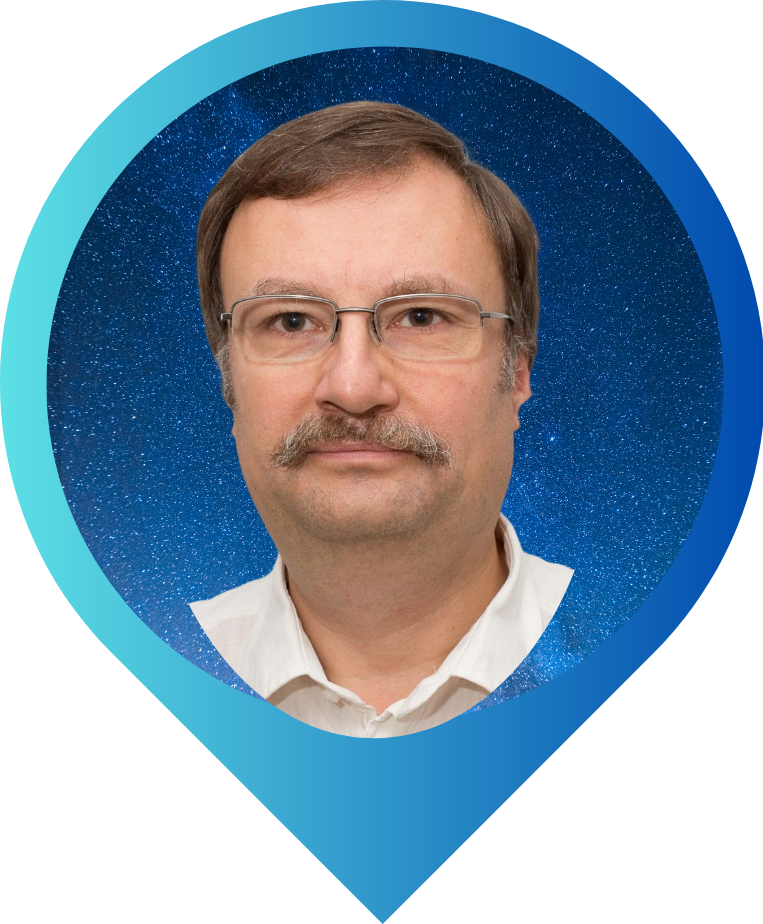 Adam Kapovits, Eurescom GmbH, Germany
Adam Kapovits is a Project and Programme Manager at Eurescom, where he has worked since 2000, bringing over 25 years of experience in academic and industry research. He has managed numerous international studies and collaborative projects focused on networking, supporting the priorities of European telecom operators and the wider communications industry. His work covers strategic research coordination, stakeholder engagement and innovation management, with a strong emphasis on aligning technical developments with industry needs and European research agendas.
 Maria Guta, European Space Agency, The Netherlands
Maria Guta is a Senior 5G/6G Non-Terrestrial Network Architect at the European Space Agency (ESA/ESTEC), with more than 20 years of experience in satellite communications and integrated network architectures. Her work focuses on the convergence of satellite and terrestrial technologies to support future 5G and 6G systems. She leads strategic initiatives within ESA’s Directorate of Telecommunications and Integrated Applications, contributing to programme development, technical coordination and long-term innovation planning across a wide range of non-terrestrial networking activities.
 Tomaso de Cola, DLR, Germany
Tomaso de Cola is the Area Director of the Space Internetworking Services Area at DLR, with extensive experience in satellite communications and networking research. He has served on the Technical Programme Committees of many IEEE international conferences and chaired satellite tracks at several ICC and Globecom editions. He has also acted as guest editor for various IEEE journals and magazines. An active IEEE ComSoc member, he previously chaired the Satellite and Space Communications Technical Committee and received the 2020 Distinguished Service Award for his contributions.
 Helmut Zaglauer, Airbus, Germany
Helmut Zaglauer is a Senior Expert in Services, Network Management and Standardisation at Airbus Defence and Space, with over 30 years of experience in space systems engineering, telecommunications and advanced research. He currently leads and manages major 5G Non-Terrestrial Network initiatives, contributing to projects such as 5G-AUTOSAT, 5G-ROUTES and 5G-IS, while supporting innovation in 5G/6G architectures and space-based infrastructures. His career includes senior engineering and project management roles across industry and research organisations, where he has coordinated complex technology developments and multidisciplinary teams.